Private Label Cosmetics in China: Matching the Brief to the Factory
A supplier can only quote what your brief describes. Give a factory six clear inputs and you get a price, a schedule and a sample plan; leave any of them vague and you get a range that is wide enough to be useless. The size of the run matters most, since the usual minimum is 1,000–5,000 units per product and a 500-unit startup entry is available for first runs.
Key takeaways
- A brief needs six inputs: category, formula route, quantity, pack, market and claims.
- Private label minimums usually fall between 1,000 and 5,000 units per product.
- A 500-unit startup entry exists for a first, test-sized run.
- A library of over 10,000 mature formulas can be picked from and adjusted for scent, texture, skin feel and efficacy.
A brief is a quotation input, not a story
Many brand owners open with a paragraph about their vision. That paragraph is fine to keep, but it does not help a factory price the work. A quotable brief is closer to a form than a pitch: it states facts the production team can act on, in the order the team uses them. When the facts are absent, the supplier either guesses or asks, and both paths cost a week.
The test is simple. Hand your brief to someone who will not see the follow-up call and ask them to repeat what is being ordered. If they cannot name the category, the quantity and the pack, the brief is not ready. Writing it as a single page forces the choices that a phone call would otherwise postpone, and plain language beats polished language here because the factory has to translate the brief into a line plan.
The six sections every brief must carry
Six inputs do most of the work. A brief that names the product category, the formula route, the target quantity, the pack, the market and the claims can be priced without a second round of questions. Each input removes one variable from the supplier's estimate, and the estimate tightens with each removal.
The order matters less than the completeness, but route and quantity usually move the price the most, so lead with them. Pack and market shape lead time more than unit cost, and claims decide which tests run. Keep the same six headings for every supplier so the replies stack up beside each other.
| Brief input | What you write | What it changes |
|---|---|---|
| Category | The product type being made | Which line and formula family apply |
| Formula route | Existing formula or developed from scratch | Whether the window is weeks or months |
| Quantity | Units for the first run and the target run | Whether the run clears the minimum |
| Pack | Container, closure and carton | Pack lead time in the schedule |
| Market | Where the product will be sold | Which rules and paperwork apply |
| Claims | The label language you intend to use | Which tests must be booked |
Category and route set the first two answers
Category narrows the equipment, and route decides the calendar. A brand that owns a formula and asks a factory to scale and fill it is using the OEM path, which usually takes 3–6 months because development, testing and production all sit inside that window. A brand that picks and adjusts an existing formula is using the ODM path, which typically runs 4–8 weeks.
Because these two windows differ by months, the route belongs in the first line of the brief. A factory reading a brief cannot tell which path you mean unless you say so, and the same product can be quoted either way. Naming the route removes the largest single source of schedule error, and it is also the first question a factory asks when a brief arrives without an answer. Buyers comparing private label cosmetics manufacturers in China usually sort the list by route for exactly this reason.
Quantity and pack decide the run
Quantity is where a brief stops being a wish and becomes a run. The published figure for private label work is a minimum of 1,000–5,000 units per product, with a 500-unit startup entry offered for first runs. State both your first run and your target run, because a factory prices the first and plans the second.
Pack sits next to quantity. A container that must be sourced adds lead time that no filling line can compress, and the published list of schedule influences names packaging lead time alongside ingredient sourcing and stability testing. When you shortlist private label project notes, check that the pack you have in mind is something the factory can actually fill.
Worked example: sizing a three-product first run
Suppose you launch three products and want to test the market before committing to a large buy. Use the published minimums as inputs: a 500-unit startup entry, 1,000 units at the low end of the usual band, and 5,000 units at the high end. At the startup entry the first run is 3 × 500 = 1,500 units. At the low end it is 3 × 1,000 = 3,000 units. At the high end it is 3 × 5,000 = 15,000 units. The spread between the smallest and fullest first run is 15,000 − 1,500 = 13,500 units of stock. If a product sells 100 units a month, 500 units covers 500 ÷ 100 = 5 months, while 1,000 units covers 1,000 ÷ 100 = 10 months. On those numbers the startup entry turns cash into stock for five months, and the low end of the band for ten.
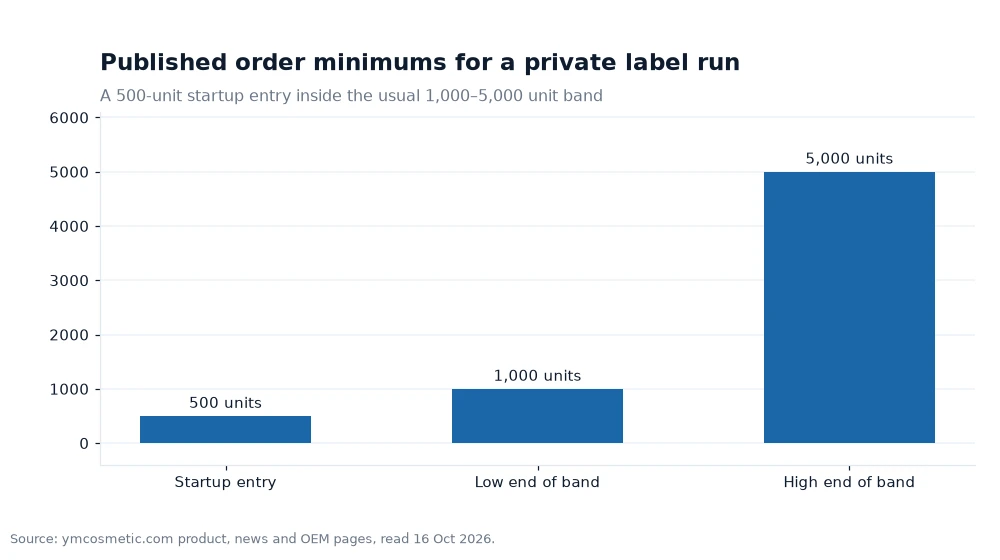
The two numbers to read first are the 500-unit startup entry and the 5,000-unit high end. The startup entry is one tenth of the high end, since 5,000 ÷ 500 = 10, which is the difference between a test-sized buy and a full retail commitment. Read the bars as choices rather than limits: the same product can start at 500 units and move to 5,000 once the sell-through data invites it.
Market and claims close the brief
The last two inputs look small and behave large. Market decides which rules and documents apply, and claims decide which tests must run before a label can carry the wording. A sensitive-skin claim, for example, leans on patch test results, while stability and compatibility reports take 3–6 months and therefore belong in the schedule, not in a footnote. If a market carries its own paperwork, name the market so the documents are priced with the product rather than after it.
Write claims as finished label sentences rather than intentions. A factory can price a stated claim; it cannot price a maybe. When a claim is drafted in the brief, the testing conversation happens before the order instead of after.
Frequently asked questions
What must a brief include before a supplier can quote?
A quotable brief names the product category, the formula route, the target quantity, the pack, the market and the claims.
What is the usual minimum order for private label cosmetics?
The usual minimum is 1,000–5,000 units per product, with a 500-unit startup entry available for a first run.
Can an existing formula be adjusted rather than rebuilt?
Yes. The published service list includes fine-tuning of fragrance, texture, skin feel and efficacy, and more than 10,000 mature formulas are available for selection.
Send the brief before the price request
Draft the one-pager, then send the same document to two candidates and compare the replies line by line. A brief that answers six questions turns a price request into a decision, and it also tells you which factory read it carefully. The Yunmei OEM and ODM overview shows how that OEM/ODM work is described for brands preparing a brief.
Published capacity, quality and route figures were read from the company's website on 16 Oct 2026.[1]